Worksheet
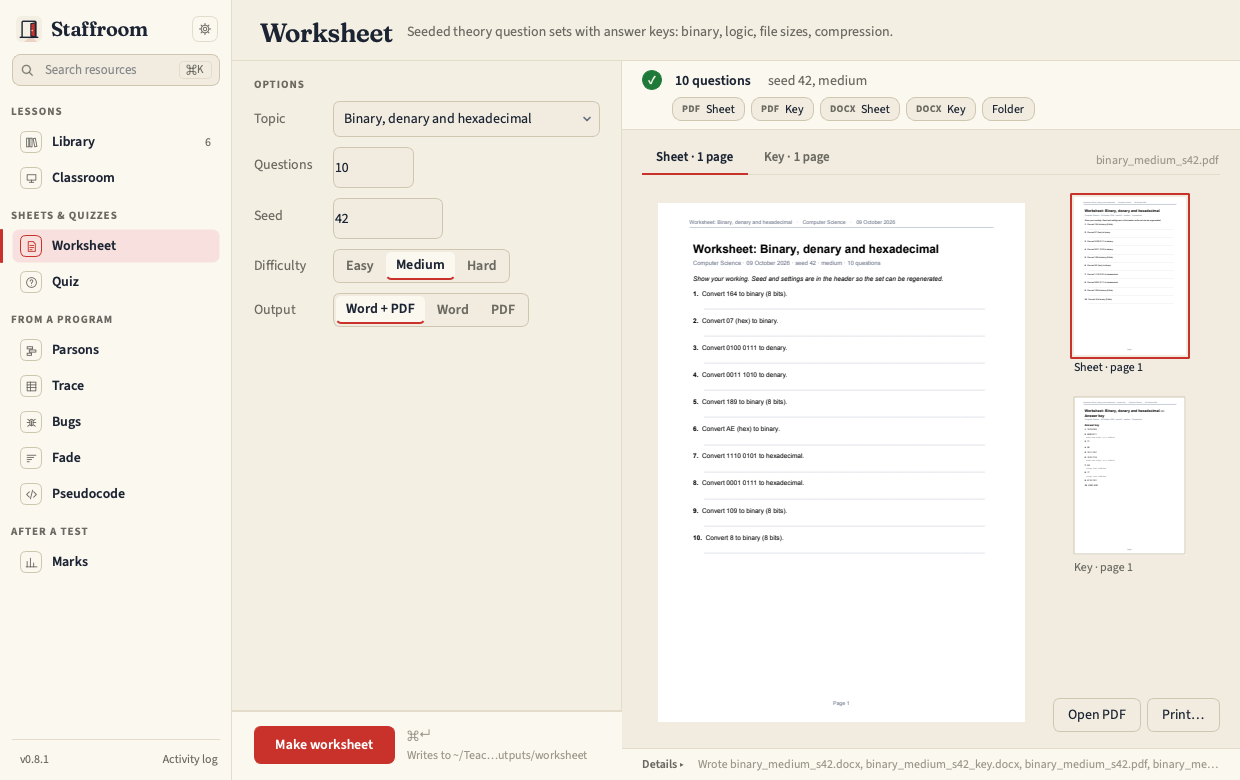
Seeded sets of theory questions with answer keys. The seed, difficulty and count are printed in the header so a set can be regenerated. A count outside 1–60 is refused with a sentence rather than writing an empty sheet.
Topics
| Topic | What it asks |
|---|---|
| binary | denary ↔ binary ↔ hex (4, 8 or 12 bits by difficulty) |
| twos_complement | 8-bit two's complement both ways |
| binary_addition | 8-bit addition with the overflow flag |
| shifts | logical and arithmetic shifts and their effect |
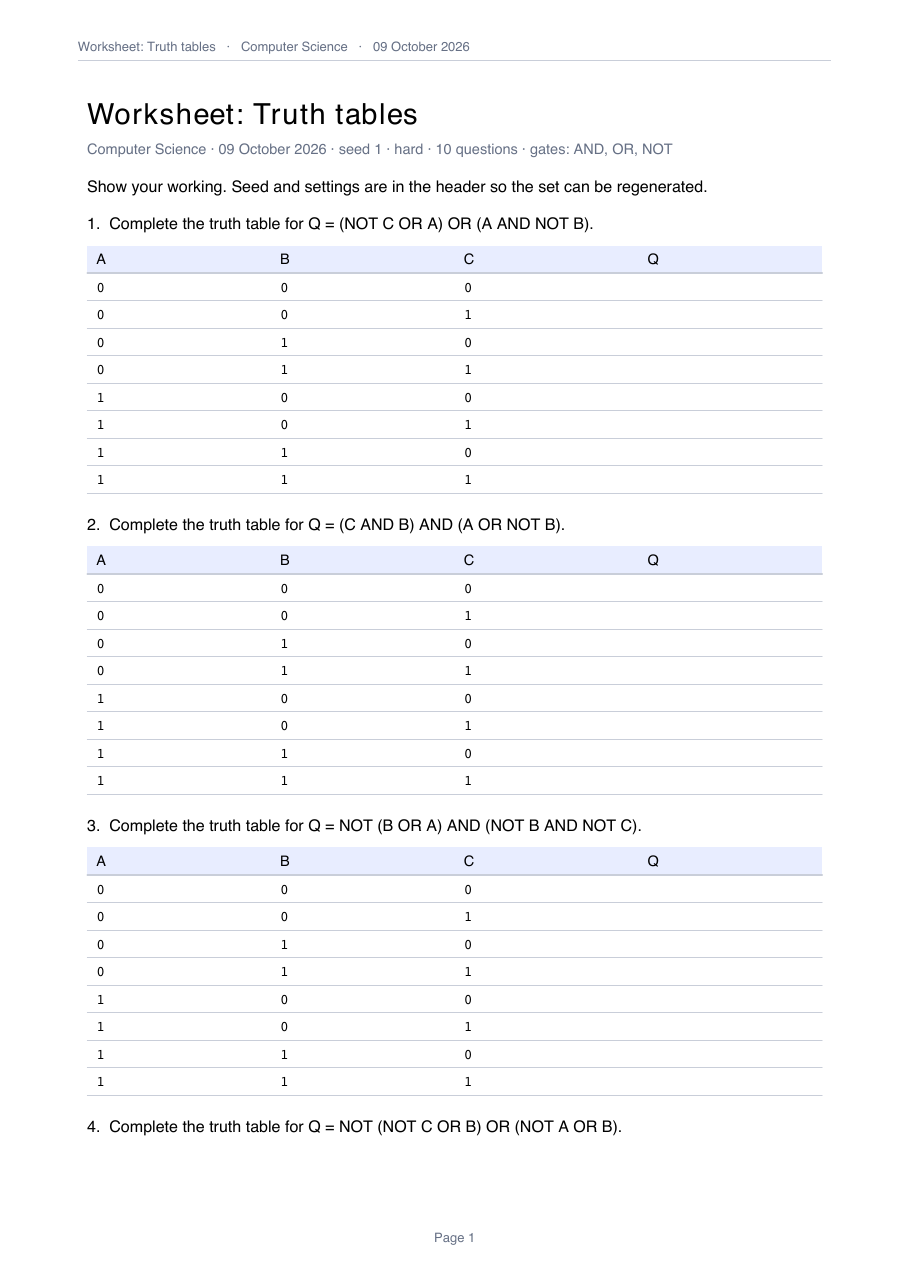
| truth_tables | 2 or 3 inputs; the gates follow the board and level (below) |
| boolean_simplification | with each law written in the question's own letters in the key |
| file_size | image, sound and text calculations |
| rle | run-length encode and decode |
| huffman | total bits for a small frequency table |
Every generator is verified in the tests by independent computation.
Logic questions
Truth tables use the gates the exam board requires: OCR J277 is AND, OR and
NOT; AQA 8525 adds XOR. Neither GCSE board has NAND or NOR, so those appear
only when Level is A level (--level a_level) and Difficulty is
Hard (A-level also
adds XOR at every difficulty). The board comes from Settings (general.board)
or --board. Every question uses all of the inputs its table lists, no gate is
fed the same input twice, and Q is never constant or simply one input. Each
difficulty has its own shape: easy is one gate on two inputs, medium two gates
((A AND B) OR NOT C), hard three gates or a NOT over a bracket
(NOT (A OR B) AND (C AND NOT B)).
Boolean simplification builds each question from textbook forms: a law wraps
one letter (or NOT letter), or one small gate, in its longer form —
absorption A OR (A AND C), the distributive pair (A AND B) OR (A AND NOT B),
the redundancy form A AND (NOT A OR B), De Morgan NOT (NOT A OR NOT B) —
and the key undoes the wraps in order, each step in the question's own letters:
absorption: B AND (B OR NOT C) = B, leaving A AND B. Easy is one step, medium
two, hard three, and a question stays the size of an exam one at every
difficulty (a hard sheet reads (A OR (A AND C)) AND NOT (A AND NOT B), not a
form nested inside a form inside a form); a sheet never repeats a question.
Boolean laws chooses what is practised: Absorption (absorption:
absorption, distributive and complement; the default), Absorption + De
Morgan (de_morgan), Identities (identities: identity, idempotent,
double negation, complement; the only family that puts X AND X, NOT NOT
X or 0/1 on the sheet) or All laws (all). The panel shows Level
only for truth tables and Boolean laws only for Boolean simplification.
The header names the gate set or the law family next to the seed, so a sheet
describes the settings that regenerate it; an A-level sheet also gets alevel
in its file name so it never overwrites the GCSE sheet with the same seed.
staff worksheet make --topic binary --count 20 --seed 42 --difficulty medium
staff worksheet make --topic truth_tables --difficulty hard --level a_level --board aqa
staff worksheet make --topic boolean_simplification --laws de_morgan
staff worksheet topics
Output: <topic>_<difficulty>_s<seed>.docx/.pdf plus a _key file, in the
house style, in ~/TeachingSessions/outputs/worksheet/
unless Settings names an output folder (Outputs).
Seed, level and Boolean laws are in the Glossary.